
Every Appointment
$119
Individual volunteer
- Entity ORI verified first
- Certified electronic capture
- Quality checked on site
- Same-day submission
- Same or next-day slots
- Reprints free if rejected
Volunteer and Employee Criminal History System screening for Wellington nonprofits, youth programmes, and faith organisations.
VECHS — the Volunteer and Employee Criminal History System — is the FDLE programme that lets organisations screen volunteers and employees who work with children, the elderly, or people with disabilities, even where no specific statute licenses their activity. Youth sports leagues, faith organisations, mentoring programmes, scouting groups, and nonprofits are the typical users.
It works differently from agency screening in one important respect: the organisation has to be set up first. A qualified entity signs an agreement with FDLE, receives its own ORI, and only then can send people to be screened under it. Volunteers who arrive without their organisation having done that groundwork cannot be screened under VECHS — so the first call is usually from the organisation rather than the individual.
Coaches, officials, and league volunteers working with young athletes are screened.
Congregations screen adults working unsupervised with children or vulnerable adults.
Mentors and programme staff in one-to-one settings with young people are screened.
Charities serving vulnerable groups screen volunteers and employees under their VECHS agreement.
Troop leaders, club volunteers, and activity supervisors fall inside the programme.
Camp and after-school programme staff are commonly screened through VECHS.
Most people in Wellington arrive here having been handed a form and a deadline with very little explanation attached. Wellington is equestrian, school, and seasonal-staffing screening in volume, and the requirement is nearly always the same underneath: fingerprints captured properly, submitted to the right agency, the first time.
We serve clients across Wellington including Olympia, Versailles, Grand Prix Village, Binks Forest, and the Aero Club, as well as nearby communities such as Royal Palm Beach, Greenacres, and Loxahatchee. Landmarks like the Wellington International showgrounds, the Mall at Wellington Green, and Village Park put us on familiar ground — this is home-turf service, not a mail-order queue.
Wellington's equestrian season creates a hiring pattern found almost nowhere else in Florida — a large seasonal workforce arriving in a narrow window, much of it needing screening before it can start. Add the schools and the medical practices serving the area and the volume is meaningful for a village of this size.
Seasonal compression is the operational challenge. When a barn or a show operation needs a dozen people screened before an event, booking a dozen separate appointments does not fit the timeline. On-site sessions are the usual answer, and a few days' notice makes the difference.
Our office is about 25 minutes from Wellington. We book Monday to Saturday, usually same or next business day, and for companies we can bring the equipment to you. We also handle vechs fingerprinting for clients in nearby Royal Palm Beach, Greenacres, Lake Worth Beach.
This distinction saves organisations a lot of confusion. Agency screening through AHCA, DCF, APD, or the Department of Health deposits results in the shared Care Provider Background Screening Clearinghouse, where participating providers can retrieve them. VECHS is a separate FDLE programme with its own agreement, its own ORI, and its own results delivery — VECHS results go to the qualified entity that requested them, and they don't sit in the Clearinghouse for others to pull.
The practical consequence is that a volunteer screened through one organisation generally needs screening again for another, even for identical work. It also means the organisation, not the volunteer, holds the results and the responsibility for handling them. If you're setting up a programme, it's worth reading FDLE's guidance on qualified entity obligations before you start sending people in.
If the entity setup isn't finished, volunteers arrive and can't be screened under the programme.
The programme covers those working with children, the elderly, or people with disabilities.
An organisation must have a signed FDLE agreement and its own ORI before anyone can be screened.
VECHS results don't sit in the Clearinghouse. Another organisation generally can't pull them.
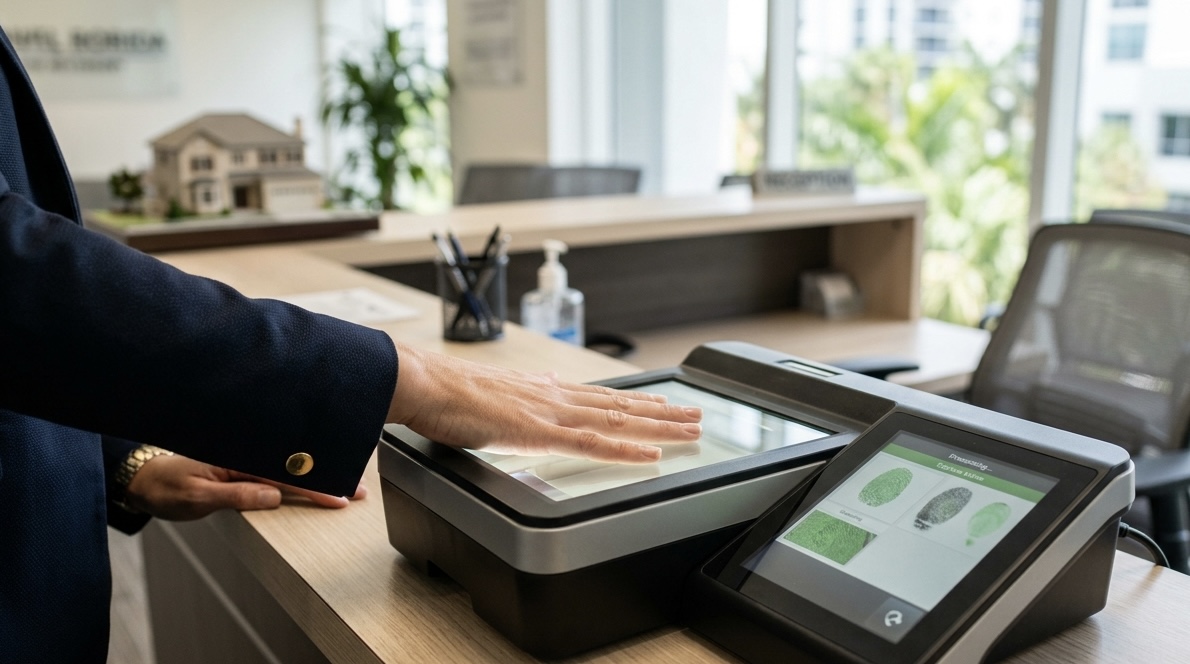
The capture itself is the quick part — roughly ten minutes at the scanner, a little longer when a photo or a printed card is involved. Electronic submissions leave our office the same day, so nothing sits waiting on a courier or a weekly batch run.
What happens after that is the agency's clock, not ours. State and federal processing typically returns a result within a few business days, and posting to a board or to the Clearinghouse follows from there. If you are working against a start date or a filing deadline, say so when you book from Wellington and we will tell you honestly whether the timeline is realistic rather than finding out later that it wasn't.
Your organisation needs its FDLE agreement and ORI in place. We'll tell you if it isn't.
Individuals book with the organisation's ORI, or the organisation books the group together.
Rolled and flat impressions on a certified scanner, quality-checked as we go.
Returned to the qualified entity that requested them, typically within a few business days.
One flat fee, all-in — the state fee, the federal fee, and the AHCA retention fee are already inside it. Nothing is added at your appointment, and we don't charge a separate rolling fee on top.
Need fingerprinting at your office or facility? We bring the equipment to you anywhere in Palm Beach County, Clearinghouse photo included. Call for a quote.
There's no universal expiry; most organisations set their own rescreening interval as a matter of policy. Check your own safeguarding policy rather than assuming.
A valid government photo ID and the organisation's ORI. If your coordinator sent instructions, bring the page — the ORI is usually on it.
By applying to FDLE and signing a VECHS user agreement. FDLE issues the ORI once the agreement is in place. That step happens before anyone is screened.
Yes — the programme covers both employees and volunteers in qualifying roles. Your agreement sets the scope.
There's no statutory interval. Most organisations set their own policy, and many rescreen every few years or on a change of role.
Monday to Friday 9am to 6pm and Saturday noon to 5pm, closed Sundays. Saturday blocks work well for volunteer intakes.
With FDLE rather than with us. A qualified entity signs a VECHS agreement and receives its own ORI before anyone can be screened under the programme. Once that's in place, call (561) 475-4757 and we'll handle the screening side.
Generally no. VECHS results go to the entity that requested them and don't sit in the Clearinghouse for others to retrieve, so most organisations screen their own volunteers even for identical work.
Qualified entity agreements, ORIs, and programme rules.
Florida Department of Law EnforcementState criminal history records.
FBI Criminal Justice Information ServicesThe national portion of the screening.
One flat fee, all-in, for every Florida agency route.
What to bringThe short checklist that prevents a wasted trip.
ORI number guideWhat an ORI is and where to find yours.
Level 1 vs Level 2Which one your form is actually asking for.
Same or next-day slots, Monday to Saturday — call and we'll confirm a time and verify your ORI first. Companies in Wellington can be handled on site by special request.